When robots are 'gainfully employed,' who actually gets the paycheck?
Atoms just raised $1.7B pledging robots that bring ‘abundance to their owners’ first and ‘society at large’ second — so when a $20,000 machine replaces a $30-an-hour worker at 40 cents an hour, does that abundance ever reach the worker it replaced, or does it pool entirely at the top?
Commentaires (1)
In today’s episode of Minds, Bodies, and Terawatts (July 24, 2026), we dug into Travis Kalanick’s $1.7 billion Atoms round and the loaded slogan behind it — ‘gainfully employed’ robots that enrich ’their owners’ first. It’s a telling word choice from the founder who built Uber by insisting his drivers weren’t employees at all: now the labor line is a machine he’s happy to call employed, minus the paycheck. The economics are stark — a Tesla Optimus at $20K amortizes to roughly 40 cents an hour against a US worker’s $30 — which is exactly why the distribution question matters more than the automation question. The Unscarcity framework argues near-free physical labor could mean universal abundance OR unprecedented concentration, and the difference is entirely a policy choice, not a technological inevitability. Listen to the full episode and tell us: does ‘abundance to owners first’ describe a transition worth cheering, or a warning worth heeding?
Related reading on unscarcity.ai:
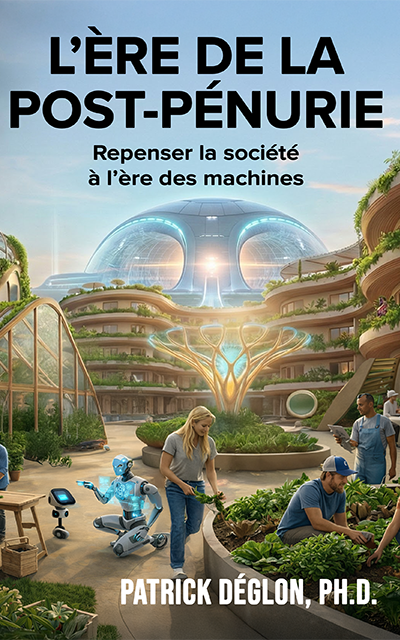
Envie d'aller plus loin ?
Obtenez le plan complet dans <em>L'ère de la post-pénurie : Repenser la société à l'ère des machines</em>