Manufacturing Customization at Scale
Somewhere in every thread about free robot labor, a skeptic asks this. A composite of the versions we keep seeing:
“Fine, robots make everything and nobody pays. But who decides what they make? If it’s one system feeding eight billion people, I’m picturing one approved couch, one model of boots, one gray jacket. Custom stuff costs a fortune today. Does abundance mean I get plenty of things, but only the standard ones?”
The worry has two halves, and they need separate answers. The first is economic: can a machine-run economy make a thousand variations as cheaply as it makes one? The second is political: when there’s no price to signal what people want, who decides what gets built at all? Unscarcity takes the second half more seriously than the first, because the twentieth century already ran that experiment and the results are on record.
Why Custom Costs Extra Today
A bespoke jacket doesn’t cost more because it uses more cloth. It costs more because somebody has to measure you, cut a pattern that exists once, and do by hand what a production line does by repetition. Standardization is how industry spread one expensive setup across millions of identical units. Customization means paying for the setup again.
So the real question is what happens to the cost of setup. Material and energy matter, but the expensive part of “different” has always been the human hours of reconfiguring: retooling the line, reprogramming the machine, re-planning the sequence. If that cost collapses, the old trade-off between cheap-and-identical and expensive-and-yours collapses with it. If it doesn’t, abundance really would look like a warehouse of gray jackets.
The honest answer is that the cost is falling, and the place it falls first is not the robot’s hands but its software.
From the Podcast: The Bottleneck Was Never the Arm
The March 30, 2026 episode of Minds, Bodies & Terawatts, our daily podcast, covered a funding round that looks like a niche story and isn’t: Mind Robotics raises $115M Series A at $2B valuation. The company builds no robots. It builds the software layer meant to run on everyone else’s, “everything from low-level motor control… all the way up to high-level task planning.”
The episode’s most useful line came in answer to the question of what the coverage missed: “the real bottleneck in industrial automation has always been integration. Getting a robot to work reliably in a specific factory with specific parts and specific workflows takes months of custom engineering.” The guest put the stakes as a contrast between two kinds of robot. One “takes six months and two million dollars to integrate” and so only shows up at major corporations. The other takes “two weeks and fifty thousand dollars” and shows up everywhere.
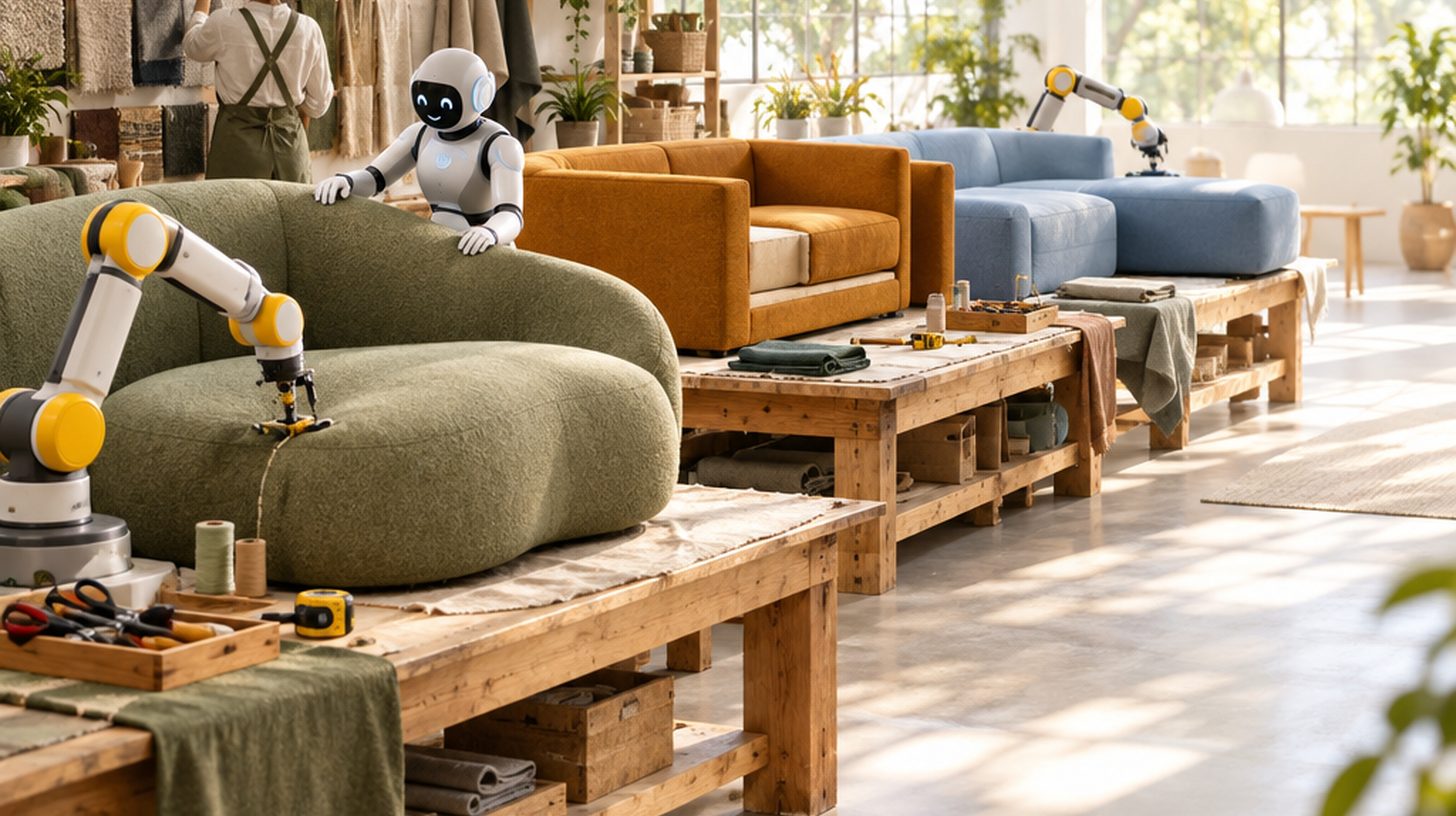
Read that with customization in mind. Integration is setup cost, the exact thing that makes a one-off expensive. A robot that has to be engineered for months around one product will make that product forever. A robot that can be re-pointed at a new task in days can make short runs, odd sizes and single pieces without the economics breaking. The episode also described the data flywheel behind the bet: “Robot number one thousand learns from the mistakes of robots one through nine hundred ninety-nine.” Each reconfiguration makes the next one cheaper.
The episode didn’t oversell it. The valuation prices in network effects that “haven’t materialized yet,” and if a single company ends up owning the intelligence layer, it gains “leverage over global supply chains.” Cheaper reconfiguration is a capability, and who controls it is a separate question.
Who Decides What Gets Made
That separate question is where the skeptic’s gray jacket comes from. People who grew up on Cold War history have seen what a planned economy produces. Chapter 9 of Unscarcity doesn’t argue with the memory: the Soviet road “ended with shelves full of things nobody wanted and shortages of things everyone needed.” Set quotas by weight and factories made unusable railroad spikes; set them by count and they made useless tacks.
The book’s alternative is coordination without a central planner. The research note on Guild coordination argues that prices were a compression scheme for an era when information was expensive, and that real-time demand signals can now do the job directly. It is also candid about where the machine falls short, and that candor matters most for customization. In the M5 forecasting competition, run on 42,840 of Walmart’s own sales series, the winning machine-learning entry beat the best classical method by 22.4 percent. At the level of a single product in a single store, the gain shrank to 3.4 percent. In the note’s words, “The machine sees the forest far better than it sees one tree.”
A forecast can tell a system roughly how many jackets a region needs. It can’t tell it that you want yours in olive with a longer sleeve. Customization doesn’t come from prediction. It comes from asking: the request goes in, and the thing gets made to it.
The note’s model for handling requests is to automate the routine and escalate the exceptional. Most requests are approved automatically. An unusual one, its example being a Guild member asking for an odd quantity of rare-earth minerals, isn’t blocked; it’s flagged for peers, who ask what it’s for. “We’re prototyping a new battery design” gets approved. The system’s answer to “different” is a question, not a refusal.
Where the Hand Still Matters
Even with cheap reconfiguration, not every custom thing is a manufacturing problem. Chapter 9 follows Ines, Maria Delgado’s sister, who keeps cooking her grandmother’s Puerto Rican recipes after the Foundation takes rent off her mind. Her restaurant stays open “not as a business but as a craft.” The chapter’s own summary of the pattern: “Some people just want to run a good corner store, design beautiful things, cook their grandmother’s recipes.”
Some customization will come from robots that can be retasked in days. Some will come from people like Ines, making things one at a time because they care how they turn out. Neither depends on a planner approving a catalog.
On unscarcity.ai: The Research Behind This Answer
Guild Coordination: Economic Planning Beyond Prices takes on Hayek’s objection directly, with the Google Maps model, Ostrom’s design principles, and the forecasting limits quoted above. Robots That Build Abundance makes the companion point about where cost hides: the solar panel got cheap long ago, and the expensive part was the human hours of assembly, until robots let an eight-person crew go from about 800 panels a day to 3,000 to 4,000. The Chapter 9 companion summarizes how corporations become Mission Guilds.
In the Book: What Happens to Volvo?
Chapter 9, “The Enterprise EXIT (From Profit to Purpose),” opens with the customization question in its rawest form. March 2053, the executive dining room of the old Volvo factory in Ridgeville, South Carolina. Chen Wei, a transition advisor with no authority of his own, tells forty-seven people, welders, battery chemists, logistics coordinators and a few former managers, that they need to decide three things: “What we build. How we decide what to build. And what happens when we disagree.”
The room erupts. A welding team lead wants to keep making sedans. A battery researcher wants to pivot to grid storage. An apprentice suggests electric aircraft. “Nobody is in charge. That’s the point. It’s also the problem.”
In the section “What Happens to Volvo?” the book lays out three roads for every manufacturer reaching that fork, from Ford in Dearborn to BYD in Shenzhen: the state seizes the factory, the factory dissolves, or it transforms into a Mission Guild that holds its machines in stewardship. The chapter opens by conceding a point to a Cold War economist who called it the curious task of economics “to demonstrate to men how little they really know about what they imagine they can design.” Then it adds that he wrote before AI “could process more information in a second than a Soviet commissar… could in a lifetime.”
The first real decision takes three weeks and one walkout. Years later, in “A Day at the Guild,” the same Guild takes on electric aircraft after two hours of debate, “with two welders still unconvinced about the battery weight and saying so on the record.” The book follows that factory through the transition.
More questions like this one are collected on the blog page. Follow the series on Substack.