Space Exploration as a Post-Scarcity Society Priority
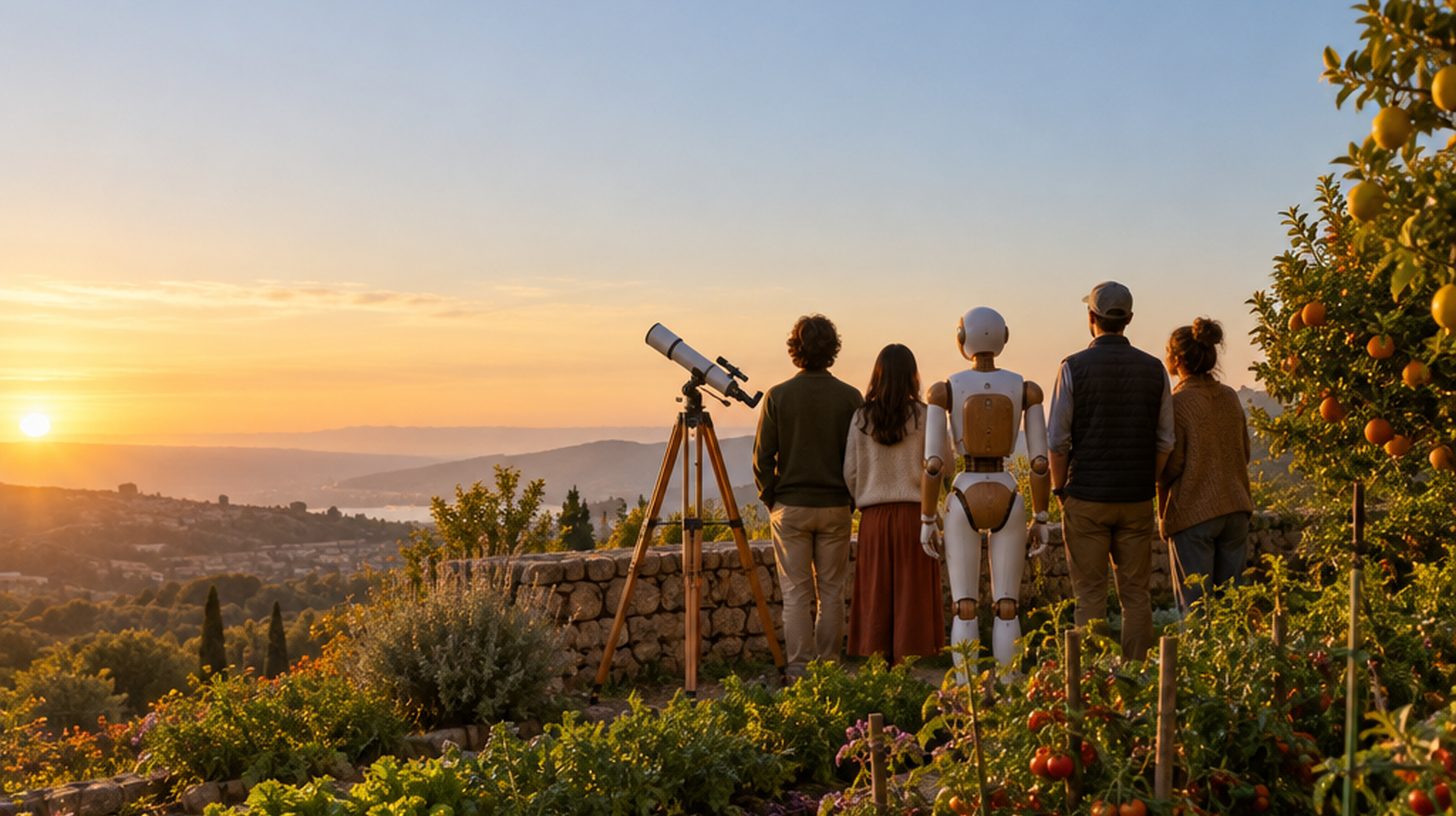
Space threads in post-scarcity forums tend to split down the middle. A composite of the question we keep seeing:
“If robots and fusion really do end want, should we pour the surplus into space? Or is Mars just a billionaire hobby we’re being asked to cheer for while people at home still can’t make rent? And if we do go, who actually gets on the ship?”
Both halves of that question have history behind them. The Preamble of Unscarcity names the complaint directly: “In 1969, we reached the moon while millions couldn’t reach their next meal.” Today, it adds, “we have pocket supercomputers and billionaires racing to Mars,” while the people the book follows are falling off the economic map.
The book’s answer is about order. Space is a genuine priority for a post-scarcity civilization, and it belongs in the second layer of the design, after survival has stopped being anyone’s problem. Put it first and you get 1969 again, at a larger scale.
Why Space Stays Scarce When Bread Doesn’t
The 90/10 Framework splits the economy in two. The Foundation provides housing, food, healthcare and energy as infrastructure. The Frontier covers whatever stays genuinely scarce even in abundance. Chapter 1 lists what lives there: “life extension, interstellar missions, consciousness research, the grand challenges that give ambitious humans something to strive for when survival is no longer the game.”
Space sits on that list because physics put it there. Our article on the Frontier walks through where the hardware stood this autumn. Starship’s Flight 14 reached orbit on September 28, 2026, the first time in fourteen attempts, and left 26 Starlink satellites in a stable orbit. It has not yet transferred propellant between two ships, which is the capability the whole Mars architecture depends on, because a Starship that reaches orbit arrives with its tanks nearly empty. That demonstration has slipped from a March 2025 target into early 2027. Crewed Mars missions are expected in the early 2030s, and each crewed ship carries 100 to 200 people.
Free energy and robot labor will make the rocket cheaper. They will not make the seat less rare. In the article’s words, “The scarcity here is not a policy choice anyone made.”
That changes what “priority” means. In a scarcity economy, every dollar spent on a launch is a dollar someone could have spent on rent, and the moral argument against space is serious. Once the Foundation is running, the launch no longer competes with dinner. The open question becomes who goes, and who decides.
Who Gets a Seat
Today the answer is whoever owns the rocket or can afford a ticket. The book replaces that with Impact, a ledger of verified contribution that cannot be bought, sold, or inherited, and that decays with a twenty-year half-life so nobody can sit on an old lead.
Chapter 2 tests it on the hardest case. The Walton heirs try to secure priority seats on the first Mars colony ship and find that their grandfather’s fortune “counted for exactly zero in the Frontier.” They can still apply. “Thirty years advancing terraforming science? Welcome aboard. Thirty years coasting? They stay on the Foundation like everyone else: comfortable, but not exceptional.”
Impact gets you into the queue; it doesn’t pick the crew. The Four Living Pillars article lists what a Mars selection would also weigh: psychological resilience (“can you handle two years in a tin can?”), the skills the mission actually needs, and the mix of expertise across the team. A large balance with the wrong skills loses to a moderate one with the right skills.
Space also gives the book an answer for one of the transition’s hardest institutional problems. In Chapter 10, an AI advisor tells a skeptical Secretary of State, a former soldier, that the military-industrial base should be re-aimed, not retired, as a Planetary Defense Corps: “Same engineers, same institutional pride, same budgets, eventually. New mission: the fusion grid, asteroid defense, disaster response.” In the same exchange, Mars colony participation is one of the cooperation benefits a nation forfeits if it cheats on AI verification. A shared space program serves as a reason to build something big, and as a deterrent too.
From the Podcast: Four Chips Chasing the Sun
The October 3, 2026 episode of Minds, Bodies & Terawatts showed the other road into orbit. Its headline: Google Put Four AI Chips in Orbit to Chase Sunlight With No Neighbors to Object. The Engineer Running It Says It Won’t Be Cheaper Than Earth for at Least Five Years.
The satellite, part of a project called Suncatcher, launched on October 1 on a SpaceX rocket. Its orbit keeps its panels almost always in sunlight, where Google says a panel makes up to eight times the power it would on the ground. The engineering is honest about its limits. Radiators are among the heaviest things on board, and the four chips can run a model for fifteen minutes before they have to stop and cool. The project lead, Travis Beals, told NPR he does not expect orbit to be cheaper than Earth within five years.
The episode’s real concern was one line NPR used: orbit is where there is “virtually unlimited free energy and no protesters.” As the guest put it, “Up there, nobody has to be asked.” A town that can refuse a data center can also demand that it bring its own power and keep it off residents’ bills. Put the building where there are no neighbors and that negotiation never happens.
The episode connects this directly to the Foundation, where energy is shared infrastructure with a baseline for everyone. “Energy without limit that one company can reach is a private supply, however clean it is.” This is the risk inside the reader’s question. Space can become the Frontier the book wants, or it can become the place where ownership finally gets away from accountability. Our analysis of the Star Wars scenario already sketches a version of it, an aristocracy that “sends their children to terraform Mars” while everyone else waits.
On unscarcity.ai: Where to Go Deeper
The Frontier covers the 10 percent that stays scarce, with the full Starship flight record and the reasons a Mars seat, a longevity trial and a vote on civilization’s direction all need an allocation rule that isn’t money. Settler Economics uses SpaceX’s Starbase, incorporated as a city in May 2025 with more than 3,400 direct employees and contractors, as a case study in how a compelling mission (“making humanity multi-planetary”) draws builders to a remote, uncomfortable place, and in what such a community needs to keep families there. Four Systems, No Ruler lays out the meritocratic queue that sits between holding Impact and boarding a ship.
In the Book: Luna’s Breakfast
The Epilogue of Unscarcity is a letter written in 2075 by Maria Delgado, the Detroit house cleaner turned painter. In the section “The World We Built,” her fourteen-year-old great-granddaughter Luna is at the kitchen table before dawn, toast forgotten beside a display of orbital trajectories: “Grandma, look. If we adjust the entry angle by two degrees, the water filters survive re-entry intact.”
Luna has never had a job. “She studies orbital mechanics because the stars call to her, not because a recruiter told her it ‘pays well.’” She earns Impact designing water filters for the Mars colonies, working with a materials scientist in Singapore and a researcher on the orbital stations. After breakfast she leaves for “dirt school,” where children learn to grow food and fix plumbing.
Maria never went to Mars. Chapter 2 explains that her twelve seats “were commissions, not berths.” She writes: “The murals I made for the first Mars settlement hang in rooms I will never stand in; Luna has promised to stand in them for me.”
The last section, “What’s Yours?,” refuses to call the project finished. Luna’s generation will inherit “the Mars colonies that still don’t feed themselves,” along with the holdout territories and the open questions about consciousness. They are handed what the letter calls “our best draft.” The book follows how Maria got from a severance check in someone else’s kitchen to murals on another planet.
More questions like this one are collected on the blog page. Follow the series on Substack.

