How Do Humanoid Robots Learn and Improve Over Time?
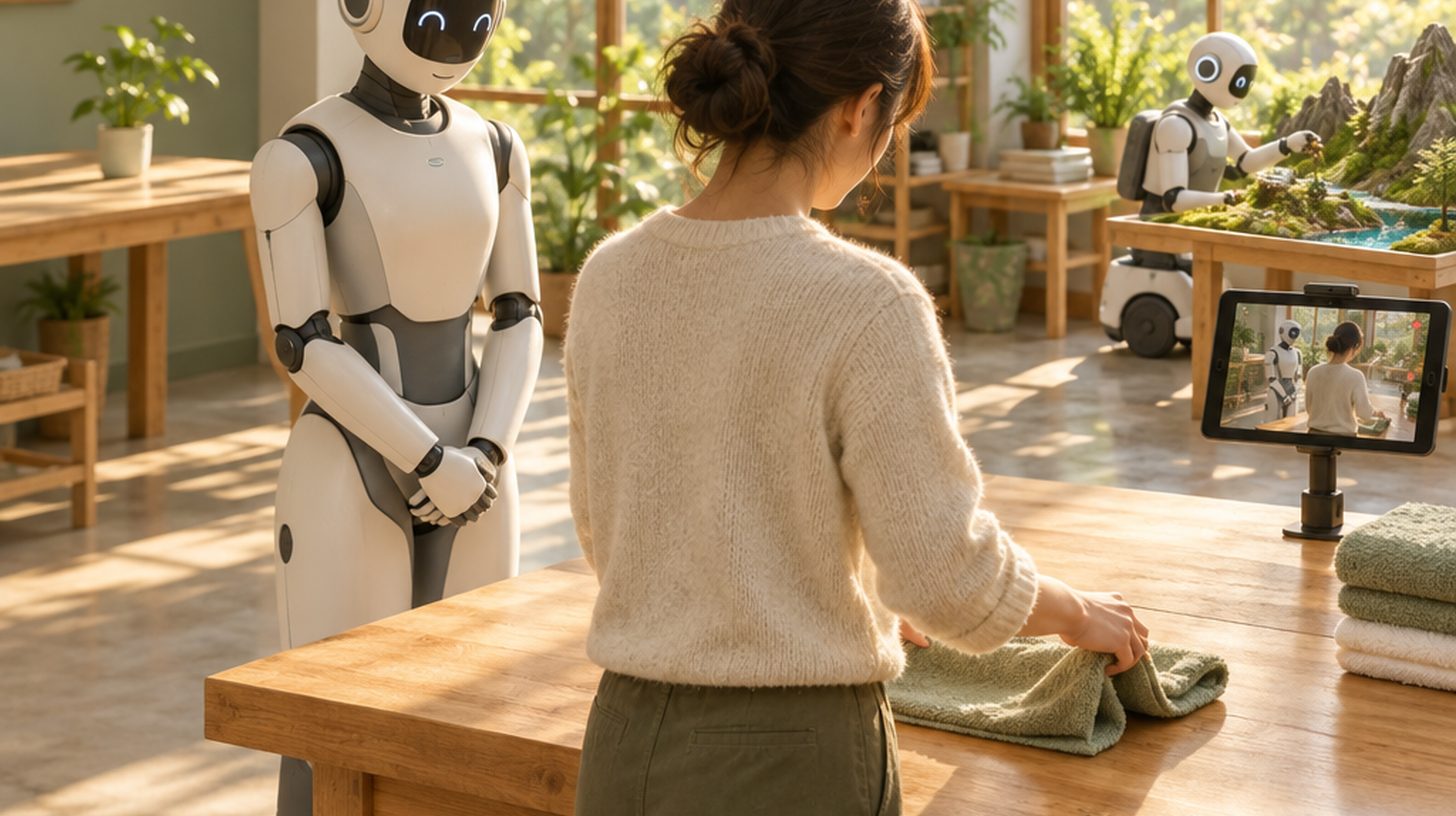
This one comes up whenever a humanoid robot video does well online. A composite of the versions we keep seeing:
“Does someone program every move, or does the robot actually get better on its own? If it drops a towel today, does it fold it tomorrow? And when one robot figures something out, do all the others know it too?”
The short answer: nobody writes the moves line by line anymore, and yes, what one robot learns can reach every robot running the same model. The longer answer is that a humanoid today has four teachers. Three of them are people.
Teacher One: The Simulator
The first teacher is a video game. Chapter 1 of Unscarcity describes engineers training robots “in hyper-realistic digital environments,” closer to the simulators pilots use to practice emergency landings, except run for thousands of robot bodies at once. In the book’s words, “One minute of real-world computing time can simulate hours of trial-and-error for thousands of digital robot twins simultaneously. We’re not programming robots anymore. We’re growing their intelligence in a time-accelerated bubble.”
Simulation is good at balance, walking and recovering from a shove. It’s weaker at the parts of the world that are hard to model: a damp towel, a sticky drawer, a dog underfoot. Those lessons have to come from the real thing.
Teacher Two: A Human at the Controls
The second teacher is a remote operator. When the robot gets stuck, a person connects, takes over the arms and finishes the job, and the robot records how it was done. 1X, the company behind the $20,000 NEO home robot, is open about it. Its CEO, Bernt Børnich, said “much of the work will be done by teleoperators in the beginning,” and owners schedule the operator’s sessions in an app.
This works, but the economics run backward from software. Tesla taught its cars by logging how its customers drove: billions of miles of real-world driving, collected for free by people who wanted to drive anyway. Teleoperation pays a person for every hour of lessons, so the cost of data climbs with the amount of data.
Teacher Three: People Filmed at Work
The third teacher is anyone willing to be recorded doing the task. This is where the money is going in 2026.
A startup called Generalist builds sensor gloves that capture finger position, grip force and release timing as a person works. Tesla has employees and hired data collectors wear motion-capture suits and camera helmets, and according to The Information it holds more than 500,000 hours of recordings, with a goal of doubling that by December. Figure went furthest. Its Index app, unveiled in August, pays people to film their own chores. At launch it had 16 million videos from 108 countries, about 94 cents paid per video, and 30 minutes of footage arriving every second. Figure has committed to spending over $1 billion on data and compute over the next twelve months.
The open problem is transfer. Human hands and robot grippers aren’t built the same, so a recording is only useful if it maps cleanly onto the robot’s joints.
Teacher Four: The Rest of the Fleet
The fourth teacher is every other robot. This answers the last part of the reader’s question. The intelligence increasingly lives in a shared model, and robots are its hands. Physical Intelligence, whose co-founder Sergey Levine describes its product as “ChatGPT, but for robots,” is building one model any manufacturer can install. If it works, every humanoid from every manufacturer gets smarter at the same time. Google DeepMind is running the same play with Gemini Robotics in Boston Dynamics’ Atlas and across Agile Robots’ 20,000-plus deployed systems, with data from partner robots feeding back into the model.
Figure’s BotQ factory was built with this in mind: every robot shipped is a training run for its Helix model. Even the shipment numbers show it. Of the roughly 25,000 humanoids IDC counted shipping in the first half of 2026, 69 percent went to research labs, classrooms, stages and government data-collection centers. Most new robots are still students.
How Improvement Actually Shows Up
So does it fold the towel tomorrow? Measured honestly, it improves in steps, and the steps are uneven.
In September, Figure tested Helix 2.5 in 30 Bay Area homes the robot had never seen, on tidying, towel folding and bed making. Trained from scratch, it succeeded 9 percent of the time. Pretrained on Index footage, 56 percent. That’s a sixfold gain from the data, and a robot that still fails nearly half the time. Tesla’s Optimus, by The Information’s account, takes several days to learn a basic task. Boston Dynamics opened a training center inside Hyundai’s Georgia plant where Atlas practices sequencing car parts, with component assembly scheduled for 2030.
The best picture of progress is a dimmer. Automation slides from “human does everything” through a long middle stage where the machine acts and a person catches the failures, and only then to unattended work. Improvement means the person steps in less often. A remote operator in the loop tells you the robot has reached that middle stage, which every hard automation problem passes through.
From the Podcast: The Workers in the Motion Suits
The September 27, 2026 episode of Minds, Bodies & Terawatts, our daily podcast, was about the third teacher and what it costs the people doing the teaching. Its headline: Tesla Is Building Hundreds of Optimus Robots a Week, Every Hand Assembled by a Person, and the Workers Asked to Teach the Robots Their Moves Said They Knew What the Robots Were For.
Citing The Information, the episode reports that Tesla had line workers wear suits that record their movements so Optimus could learn them, and that some complained they knew the robots were meant to replace them. Tesla moved the work to dedicated data collectors and training hubs in Colorado, Arizona and Florida. Its plan is to lease robots to companies with Tesla-like factories, with the data from those floors flowing back to improve the robot.
The guest named the trade plainly. A wage pays for the shift; what the workers handed over was the skill itself. When a person trains an apprentice, the teacher keeps a place in the craft. When the apprentice is a machine the company owns, “the lesson stays with the owner, and the teacher’s part ends when the recording stops.”
On unscarcity.ai: Two Articles to Read Next
Humanoid Robots 2026 keeps the running record, including its section “The Bottleneck Isn’t Bodies. It’s Data,” which compares the gloves, teleoperation and the Index app as rival ways to collect lessons. Autonomy Theater explains the dimmer: Cruise’s robotaxis needed remote help 2 to 4 percent of the time, Tesla’s 2024 bartending robots were run by staff offstage, and the article argues that the share of human help should be disclosed so the public can tell how far along the robots really are.
In the Book: The Ticket Nobody Sees
Chapter 2 of Unscarcity, “The Frontier (Solving for Meaning),” answers the episode’s closing question, whose name goes on the lessons, through Adewale Okonkwo. In the section “The Ticket Nobody Sees,” he is a self-taught Python coder in Lagos who lost his clients to AI agents. He joins Civic Service and spends three years “teaching the systems that replaced him: training models on Nigerian English, on Yoruba language and culture, … and on logistics patterns no San Francisco engineer had ever seen.”
In the book, that teaching counts. It “compounded into the Impact that put him in this control room,” coordinating the West African Solar Grid for forty million people. His AI assistant files Claims for unglamorous work, among them “a training dataset for Hausa logistics released to the open Commons.”
Set that beside the Tesla episode. The work is the same: a person showing a machine how something is done. What differs is where the lesson ends up and whose record it stays on. In Tesla’s version, the hours belong to the company. In Adewale’s, the dataset goes to a public Commons and the credit stays in his name, reviewed by engineers in Mumbai, a rural electrification council in Kenya, a historian in Chile and a Yoruba elders’ circle. The book spends the rest of Chapter 2 on how that record is kept, and on why it can’t be bought.
More questions like this one are collected on the blog page. Follow the series on Substack.