Is Post-Scarcity Actually Possible or Just Science Fiction?

Some version of this shows up under every post-scarcity thread, usually with an eye-roll attached. A composite of what we keep reading:
“Fusion has been thirty years away since my grandfather was a kid. Half the robot demos have a guy with a remote control just out of frame. Post-scarcity is Star Trek fan fiction with a spreadsheet. Convince me it’s anything more than that.”
Fair challenge. The skeptic is bundling three questions into one. Is it physically possible? Can we build it, and when? And will we organize ourselves to share it once it exists? The answers, in order: yes, slower than promised, and nobody knows. The third question deserves the eye-roll, and it has very little to do with physics.
The Physics Is Settled
The grandfather line confuses physics with engineering. The physics of fusion has been understood since the 1930s, and the sun has run on it for 4.6 billion years. What humans lacked was a container. At 1:03 AM on December 5, 2022, the National Ignition Facility in California fired 192 lasers carrying 2.05 megajoules into a fuel pellet the size of a peppercorn and got 3.15 megajoules back. More energy came out than went in, for the first time. By April 2025 the same facility had reached 8.6 megajoules of output, a gain of 4.13 at the target.
Solar shows what happens after a threshold like that. Bell Labs made the first practical solar cell in 1954, at $300 per watt and 6 percent efficiency. In 2024, utility-scale solar averaged $0.043 per kilowatt-hour worldwide. The photons didn’t change in those seventy years. Manufacturing scale, materials science and human stubbornness did, and since 2010 alone the cost of utility-scale solar power has dropped about 90 percent.
Our timeline analysis sorts the risks into four kinds. Physics risk, the chance the underlying science is wrong, rates zero for fusion, solar and robotics. Engineering, adoption and coordination risk all rate moderate to high. Those three move the date. They don’t move the possibility.
The Engineering Is Late, and the Builders Admit It
On schedules, the skeptic has a point, and 2026 supplied plenty of evidence.
Commonwealth Fusion Systems finished the first of the 18 toroidal field magnets for its SPARC tokamak in January and said all 18 would be installed by the end of summer. Eight were in by September 22. Helion deleted its promise that its Orion plant would produce electricity by 2028, and its public affairs director told a conference, “We will not, in no universe, have 50 megawatts hit full operation in 2028.” ITER, the international megaproject, pushed first plasma to 2034 and full deuterium-tritium operations to 2039, adding another €5 billion to the bill.
Robots tell the same story. Tesla’s Fremont line started building Optimus humanoids in late August, but on the October 21 earnings call Musk called it “early production” and told outside buyers to expect deliveries “around the end of next year.” 1X has taken orders for its $20,000 NEO home robot and, as of early November, had no independently confirmed delivery. The industrial side is further along: by late 2025, Figure robots were running 10-hour shifts on a BMW production line.
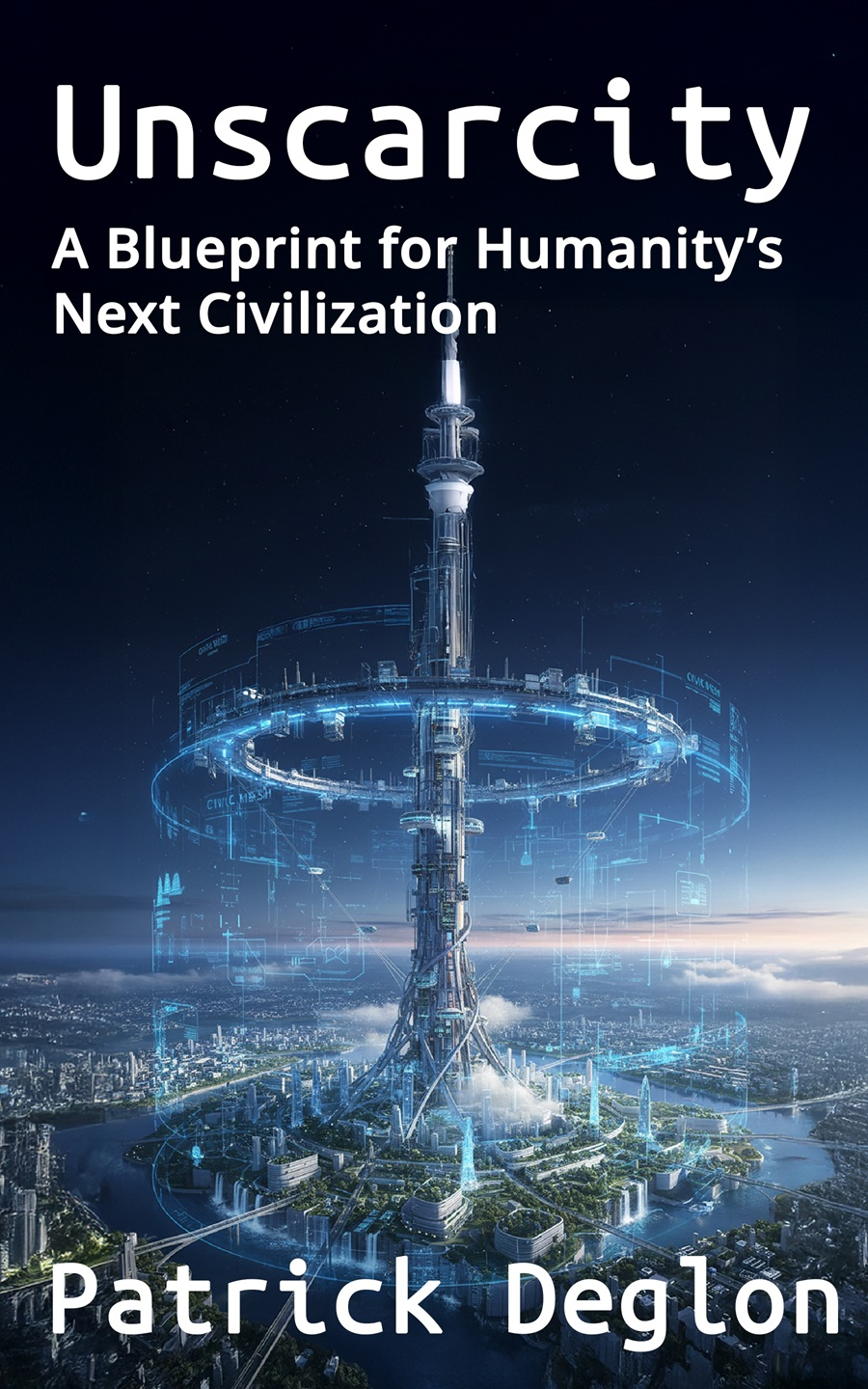
None of this would surprise the book’s author. Drawing on his own experience with large-scale physics projects, Patrick Deglon writes that timelines “routinely stretch to twice the original projection and budgets triple.” The bottleneck he flags is unglamorous: grid-scale step-up transformers, in roughly 30 percent global shortage with lead times stretched to four years.
AI is the one engine running ahead of schedule. The framework doesn’t need AGI, only AI good enough to coordinate logistics and validate contributions, and the timeline analysis counts that bar as already met.
From the Podcast: A Stock Ticker for a Star
The July 17, 2026 episode of Minds, Bodies & Terawatts, our daily podcast, caught the week fusion became a tradable asset: Fusion Energy Goes Public: General Fusion Debuts on Nasdaq as Record $14.2B Floods the Industry.
The episode refuses the victory lap. General Fusion nearly ran out of cash the year before, laid off a quarter of its staff, and reached the market by merging into a SPAC shell. But the wider numbers are hard to wave off: more than $14 billion across 56 fusion companies, 28 of which expect a first pilot plant running between 2030 and 2035. Google and Microsoft signed binding deals to buy fusion power from Commonwealth Fusion and Helion before either reactor was finished. The guest’s read: “When companies whose lawyers have lawyers sign for electricity from a reactor that isn’t finished, that’s due diligence, not a press release.” Realta is building its reactor inside a former Oscar Mayer hot dog plant in Wisconsin, and its CEO sums up the pitch as “from sausages to fusion.”
Then the episode turns to the problem the skeptic never raised. A public company lives on margin, and fusion’s promise is power too cheap to meter. In the guest’s words: “The engineering question, can we build it, is getting answered. The ownership question, who captures it once we do, is the one nobody on the trading floor is asking.”
The Part That Really Is Fiction
The book borrows the Star Trek name for its hopeful path, and admits the show left the hard part blank. Its Preamble calls this “the economy Star Trek never quite explained: nobody on the Enterprise worried about rent.” The replicator was never the fictional part. The missing piece was the institution that made rent disappear. A star we build ourselves, sold back “by the kilowatt-hour” as the episode puts it, gives shareholders cheap energy and leaves everyone else where they started.
The one date the book says cannot slip is the Labor Cliff. By some estimates, around 30 percent of current work hours could be automated by 2030, and automation doesn’t wait for fusion. If the job losses arrive decades before the abundance, Chapter 8 warns, “the gap between ‘crisis’ and ‘solution’ is where revolutions breed.”
On unscarcity.ai: The Delay Math
What If Fusion Takes 50 Years, Not 10? stress-tests the framework against bad news. It gives a probable and a worst-case date for each technology, then walks through three failure modes: fusion delayed to 2060, robot production stuck at 2 million units a year, and AI stalled at 2025 levels. Its probable window for full Foundation deployment is 2050 to 2070, with 2100-plus in the worst case. Fusion Energy 2024-2030: The $15B Commercial Race tracks the hardware company by company and keeps the ledger honest: none of these companies has sold a single commercial watt, and none will this year.
In the Book: A Note on Time
Chapter 8 of Unscarcity, “The Transition, the EXIT or the Fire,” interrupts its own timeline to argue with it. The section “A Note on Time: When Timelines Slip” concedes that commercial fusion, projected at full scale for 2040 to 2055, could face delays, and that a major war could set everything back decades. “Call it pessimism if you want. What it actually is: engineering honesty.”
Then it gives the spread. Accelerated scenarios bring commercial fusion to 2045 and a mature Foundation by the 2050s. Conservative ones push fusion to between 2070 and 2090 and full deployment past 2100, and some places never arrive at all, “the way some businesses were still running fax machines a decade after email had plainly won.”
The next section, “Systems That Bend,” is the book’s direct reply to the skeptic. The project doesn’t need all three technologies on time. If fusion is late, solar, storage and nuclear carry the energy load. If humanoids are slow, narrower automation still displaces enough labor to force the transition. “Any one of the three drivers, energy, labor, or cognition, can carry the transition alone.” Even a war that resets the clock leaves the physics standing: “The sun still proves fusion works.”
What the chapter won’t do is promise a date. The book lives in the middle of its own range, and in its words, “Maria’s grandchildren will know which timeline we actually got.” The book spends the rest of Chapter 8 on the EXIT Protocol, its plan for getting through the gap without the fire.
More questions like this one are collected on the blog page. Follow the series on Substack.