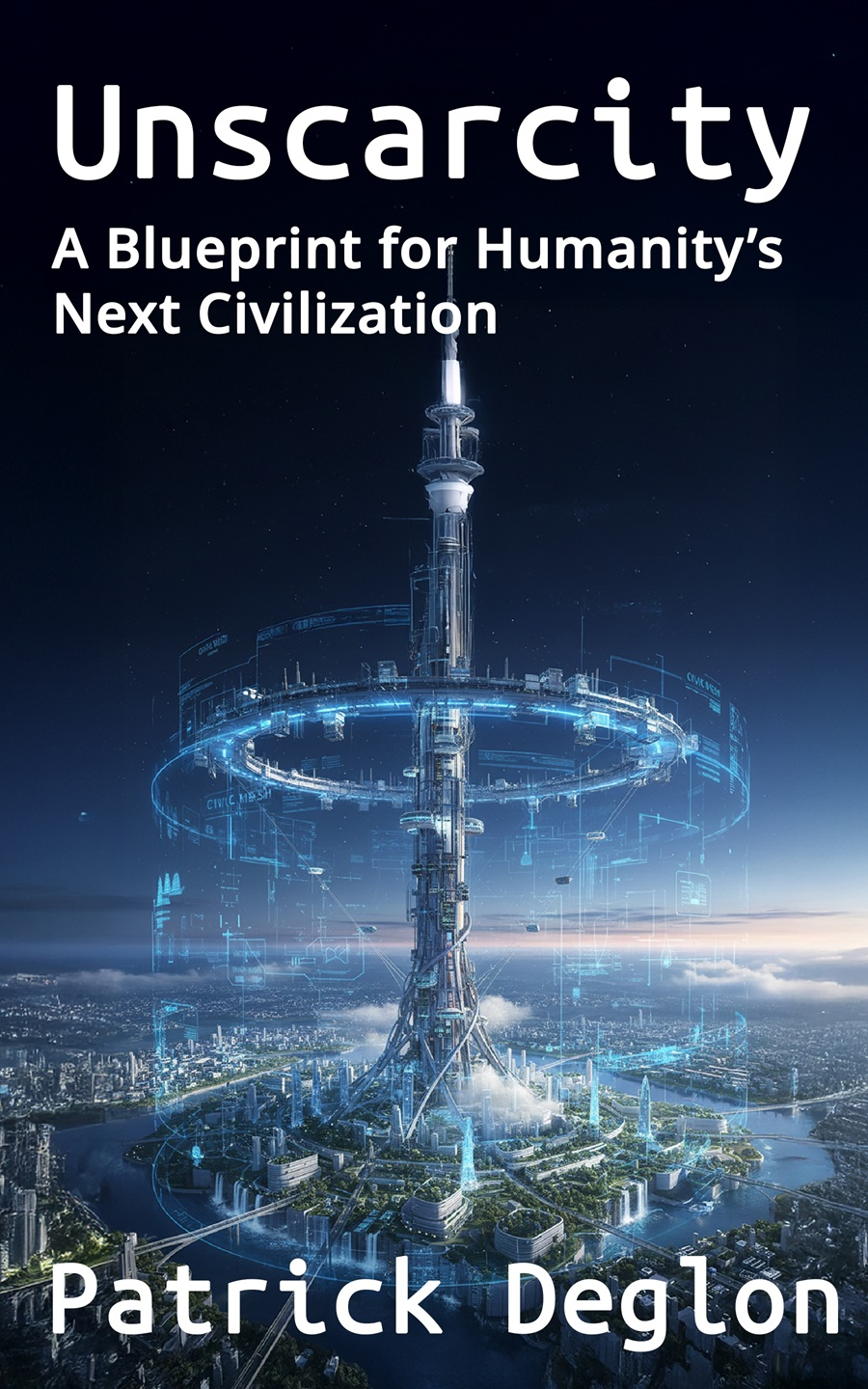
Will I Need to Work If Robots Do Everything?

The question turns up in every thread about AI and jobs, usually typed late at night. Here is a composite of the versions we keep reading:
“I’m 34. I process invoices for a logistics company. Last month I sat through a demo of software that does my whole week in an afternoon. So tell me straight: if robots end up doing everything, will I still need to work? And if I don’t, what exactly am I for?”
The person typing it wants to know what happens to them, and the question hides two smaller ones. Will I need a job to eat? Will anything I do still count? Unscarcity answers them differently, and most of the book’s first two chapters live in the gap between the answers.
The Work You Do Because Rent Is Due
In 1930, John Maynard Keynes predicted that by 2030 we would all work fifteen-hour weeks. He got the machines right. What he missed was the fine print in our economic operating system: you must labor to survive. The machines showed up, the labor line stayed on the bill, and we invented work to fill it.
Chapter 1 has a name for the category now in trouble: survival work, the labor you sell only because rent is due. Its claim is blunt: that category is mathematically obsolete. Humans aren’t. 1X lists its Neo humanoid at $499 a month, which works out to about 69 cents an hour around the clock, against a federal minimum wage of $7.25. Factory pay in Bangladesh, where garment factories go when everywhere else gets too expensive, averages well under a dollar an hour. In March 2026, for the first time in the firm’s history, “AI” was the number-one reason employers gave Challenger, Gray & Christmas for layoffs.
The curve is slower than the slide decks. Klarna’s AI assistant covered the work of 700 customer-service agents in 2024, and within eighteen months the complaints about generic, low-empathy replies forced the company to rehire humans for the cases that need someone to read between the lines. Slower, though, still ends in the same place.
So the book proposes the 90/10 Framework. Its first layer, the Foundation, covers roughly 90 percent of what there is to have: housing, food, water, healthcare, energy, transport, education, connectivity. They flow like tap water, always on, no meter running, yours because you exist. (The ratio might settle at 85/15 or 95/5. The principle matters more than the number.)
The book makes this concrete with Maria Delgado, a Detroit house cleaner it follows into an invented 2048. For most of her life, “what do you want?” was a question for people with trust funds. In 2048 she wakes at 7:14 with no alarm, in an apartment she cannot lose, and decides to paint. The chapter is explicit about how little the system asks of her in return. She gets to decide what to do with her life, “including nothing at all.”
That’s the first half of the answer. To survive, no.
Why Almost Nobody Stops There
If the answer ended there, it would describe the hover-chair humans of WALL-E, and Chapter 2 takes that risk seriously. A study in Ohsaki, Japan, followed 43,391 adults for seven years; the ones who could not name their ikigai, their reason to get out of bed, were roughly one and a half times likelier to die. The book’s verdict: “Purpose is not soft. Purpose is actuarial.”
For five thousand years, the book argues, money did double duty: the rent made mornings mandatory, and the paycheck kept score. Remove the rent and the scoreboard goes dark with it. Our 34-year-old already senses this, which is why the question has a second sentence.
Chapter 1 doubts many people will choose idleness anyway (“Humans, it turns out, are terrible at doing nothing”), and some of the answer is simply that the good part of the work stays. The nurse on double shifts keeps the part no machine is trusted with: comforting the frightened, interpreting the ambiguous symptom. The construction worker whose back is giving out at forty-five decides, supervises and trains while robots carry the beams. But the book’s larger answer is structural, and it sits in the other 10 percent.
What Still Has to Be Earned
The second layer is the Frontier: whatever stays scarce even in abundance. “Ten percent of what there is to have,” the book specifies, “not ten percent of what there is to do.” A seat on a colony ship. A place in a life-extension trial. Status, influence, a hand on the wheel of where civilization goes next.
Maria runs into it in 2052, at a community board. The Mars Colony Initiative wants artists to design living spaces for the first permanent settlement. Twelve seats. Three hundred applicants. No price, because a place on that list was never for sale.
What decides it is Impact, which the book calls “karma with receipts”: a verifiable record of contribution with three properties money never had. You can’t inherit it. In the book’s scenario the heirs to America’s largest retail fortune apply for Mars seats and learn that their grandfather counts for exactly zero. You can’t hoard it, because it decays at about 3.4 percent a year, a twenty-year half-life, so last decade’s contribution is worth less every morning. And it counts what no market ever priced. A poet whose collection was read at her city’s flood memorials earns Impact. So does a caregiver with forty years of dementia patients behind her.
So the second half of the answer is yes, in a way. Nobody will make you. Stay on the Foundation and you live, in the book’s words, “comfortable, but not exceptional.” But the scarce things, and a say in what comes next, go to people who contributed. You won’t need to work to survive. You’ll still have to contribute to matter.
The book keeps a running file on Maria, and its first entry stings. Twenty years of cleaning other people’s houses: zero Impact. “Not because scrubbing floors did not count. Because nobody was counting yet.”
From the Podcast: Why This Is a 2030 Question
The March 23, 2026 episode of Minds, Bodies & Terawatts, our daily podcast, was headlined Post-Scarcity Economics Gains Attention. It argued that post-scarcity economics has entered mainstream conversation while most people still file it under theory. Its case: AI, robotics and fusion are converging, and we have to decide how to leave scarcity-based capitalism before the Labor Cliff hits in 2030.
That date is why the question can’t wait. It is also, by coincidence, Keynes’s deadline. Even in the book’s own scenario, the first Free Zones open in the early 2030s and the Foundation doesn’t reach Maria’s Detroit until 2045. The paycheck can disappear years before the floor exists. Chapter 1 calls the end of work-to-eat an engineering reality and leaves one thing open: “whether we design a drainage system or let it flood the basement.”
On unscarcity.ai: The Two Chapter Guides
Two companion articles walk through the argument section by section. Post-Scarcity Survival: When Jobs Vanish covers the Foundation: Maria’s $300,000 apartment invoice, the three engines that erase it line by line, and why the Nordic model, universal basic income and Singapore’s forced savings all rest on a wage. Purpose After Work covers the Frontier: Universe 25, the Maya’s two economies, and how a Claim for Impact gets verified by four independent councils.
In the Book: The Foundation and the Frontier
The full argument is Chapter 1, “The Foundation (Solving for Survival),” and Chapter 2, “The Frontier (Solving for Meaning).” Chapter 1 ends on the problem it created, eight decades of unstructured time: “The wolves are gone. The mountain remains.” The section called “The Ticket Is Called Impact” defines the thing Maria needs for one of those twelve seats in three short sentences: “Not a coin you can trade. Not a score you can buy. A reputation you build, one contribution at a time.”
If our 34-year-old’s question is yours too, the book is where both halves get worked out in full. Chapter 2 follows Maria’s application to the end, including the muralist from Lyon whose feed she checked more often that year than she would admit.
More questions like this one are collected on the blog page. Follow the series on Substack.