What Does Living in Post-Scarcity Actually Look Like Day-to-Day?

Post-scarcity threads argue about fusion timelines until somebody asks the question everyone actually wants answered. A composite of the versions we keep seeing:
“Skip the economics. Walk me through one ordinary day. Do I still set an alarm? Who cooks? Do I own anything, or is it all borrowed? And once nobody needs me to work, what stops me from rotting on the couch?”
It’s a fair demand. Unscarcity answers with an invented morning, openly presented as a scenario, then spends the chapter on the engineering that morning would require. Here is the day, piece by piece, including the parts that stay hard.
The Morning: What Goes Missing First
The book’s guide is Maria Delgado, a fictional Detroit house cleaner who, in the Preamble, is told by her longest-standing client that “the robot handles it now.” In Chapter 1 she is 58, and she wakes at 7:14 in an apartment overlooking the Detroit River. No alarm goes off. None has for three years.
The first thing post-scarcity removes from a day is the list of things you must do before you’re allowed to do anything else. Her apartment cleans itself, with “quiet robots” that “manage to be efficient without being creepy.” Her pantry is stocked from vertical farms rising forty stories above old parking lots. Fusion powers everything from her reading lamp to the city’s transit pods. A healthcare AI watches her vitals and catches problems before they become problems. Her body, after decades on her knees in other people’s kitchens, no longer greets her with an inventory of what hurts.
What fills the gap is a question, and the book gives it room: “Not what she has to do. Not what will pay rent or placate a boss or keep the lights from being shut off. Just: what does Maria Delgado, human being with a working mind and a free day, actually want?”
Her answer most mornings is to paint. Her paintings don’t sell, and nobody expects her to be productive. She paints because a sunset over the river made her happy for no reason, and she wants to keep it. She isn’t good yet. Last week’s river came out muddy. She hung it in the hallway anyway.
Not One Lifestyle: Detroit and Lagos
The same chapter cuts six thousand miles east, to Adewale Okonkwo in Lagos. The Foundation there “does not look like the Foundation in Detroit.” The towers are shorter and shaded with climbing vines. The vertical farms grow egusi and ugu, two West African staples, instead of kale. Adewale, a former remote coder, now carves birds from iroko and mahogany in a converted shipping container and gives them to neighbors and their children. Today he is taking a small carved pigeon to his mother in Abeokuta, and he has nothing to do for the rest of the day “except be her son.”
What the two cities share is a function, not a style: “food arrives, power holds, the clinic knows his blood pressure before he does, and the day belongs to him.” In the book’s version, post-scarcity doesn’t standardize daily life. It lifts the same weight off very different days.
Things: Access Instead of Ownership
Your relationship to objects changes too. In the book, Maria needs a bicycle, requests it, and it arrives within hours. When she’s done, it goes back into a local pool; when it wears out, it’s recycled into the next one. The principle fits in one line: “You never really wanted to own a drill; you wanted holes in walls.”
A small version of this already runs. The North Portland Tool Library opened in a firehouse basement in 2004, seeded by a $12,000 community development grant. By 2013 it was making 7,364 loans a year to about 5,000 members and estimated it had saved them $447,205. Edinburgh’s tool library marked ten years in 2024 with 60,000 loans and an estimated £3 million saved by households.
The same research is candid about friction. In the year to March 2025, Edinburgh’s library spent £207,754 and took in £176,447, and in 2026 it moved its workshop sessions to pay-as-you-go to cover rent and electricity. Borrowing beats owning, but somebody still pays for the room. The Foundation’s wager is that robots and cheap energy end up paying for it.
The Parts That Stay Hard
Three things keep the post-scarcity day from being a permanent holiday.
First, there’s still civic work. The book proposes Civic Service, a four-year commitment usually between ages 20 and 24, with roughly a fifth of each cohort taking part. Machines run the routine; people make the judgment calls. In one scene Maria’s daughter Sophia, serving in the Local Energy Directorate in 2035, sees the grid AI propose cutting power to a “low-priority” building. It’s a community center hosting a wake for a neighborhood elder, with eighty people inside. She overrides the recommendation, and the override goes on a public record with her name on it.
Second, not everything becomes plentiful. The book keeps a priced margin, “a beachfront in Big Sur among them,” for as long as a money economy survives around it, plus a Frontier that money never buys: a seat off-world, a place in a life-extension trial. Land, location and permits are the last costs standing on the bill.
Third, and hardest, is the free day itself. Chapter 1 admits that the Foundation “hands every human eight decades of unstructured time,” and that for a species shaped by struggle, “that question is not a gift. It is a void.” The chapter leaves Maria three years into painting, “about to find out whether painting is enough.”
From the Podcast: What a Check Buys in a Year
The October 13, 2026 episode of Minds, Bodies & Terawatts, our daily podcast, put a real person roughly where Maria stands in the book. Its headline: Silicon Valley’s Answer to AI Job Loss Is a Check. The New York Times Spent a Year Watching One Land, and It Bought Diapers, Laundry and a Day at Six Flags.
The Times followed Mikole Weeks, a single mother who cleans houses part time in Santa Cruz, through a year of $1,330 a month with no strings attached, one of six pilots Google funded from a $50 million gift to Bay Area nonprofits. It also covers the cash study Sam Altman paid for: three years of unconditional money to low-income adults in Texas and Illinois. It went to groceries and rent, recipients worked an hour or two less a week, and stress and food security improved in the first year, then faded. In the episode’s words: “The check fixed the month. It never touched the job.”
A check changes what you can buy this month inside the same scarce economy, and it stops when the pilot does. The floor the episode contrasts it with “isn’t paid out at all, it’s built”: housing, food, care and power run as infrastructure, free at the point of use.
On unscarcity.ai: Where the Day Gets Its Detail
The Tool Library Revolution tells the Portland, Edinburgh and Toronto stories in full, money troubles included. Civic Service lays out the four-year apprenticeship and the limits on what a service member may override. Maria’s character profile traces the life behind that 7:14 wake-up, from losing her clients to a robot in 2028 to the community-center art class where she first picked up a brush at 55.
In the Book: Maria’s Morning and Holes in Walls
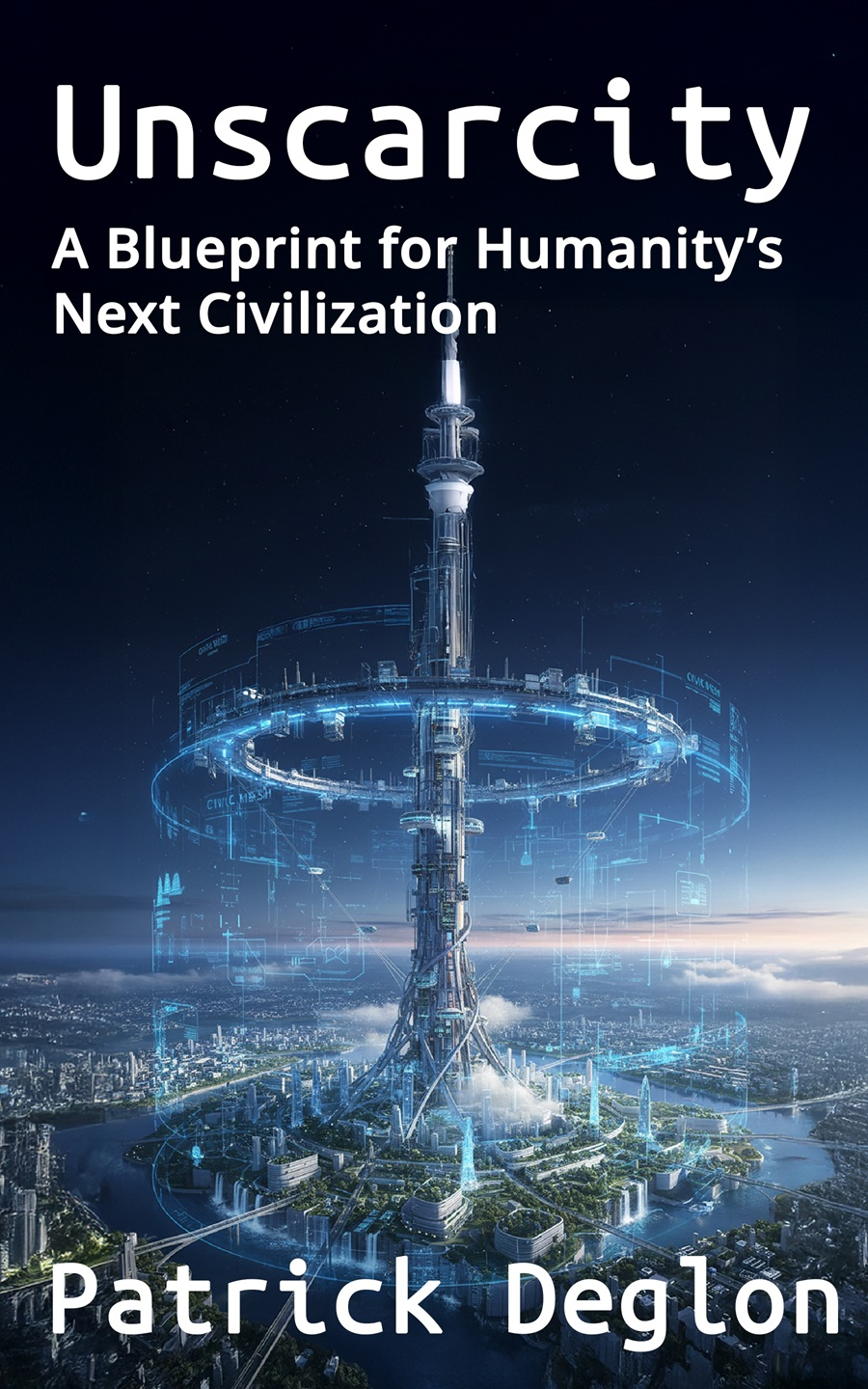
Chapter 1 of Unscarcity, “The Foundation (Solving for Survival),” opens with the section “Maria’s Morning” and refuses to treat that morning as inevitable: “Mornings like these were not dreamed into existence. They were engineered.” The chapter then itemizes how, line by line, starting with the bill for her apartment.
Later, the section “Holes in Walls” asks the reader’s question outright: “But what does daily life actually feel like?” Its answer includes the bicycle and a line that stops people. After four years of Civic Service, “you’ve technically retired. At 24.” You could spend the next eighty years painting, gardening or watching sunsets, the book says, “and the system wouldn’t blink.” Then it turns: “Humans, it turns out, are terrible at doing nothing.” The book follows that turn into Chapter 2, where Maria finds a notice for something no pool will deliver on request.
More questions like this one are collected on the blog page. Follow the series on Substack.